Almost no one decides to become dependent on alcohol. The path from “just social drinking” to alcohol use disorder is a slow, silent crossing of a line most people never see until the consequences make it impossible to ignore. Because drinking is often normalised in certain social and professional circles, this boundary stays invisible to the drinker and their family for years.
Why The Problem Hides For So Long
Early problem drinking wears a mask of social acceptability. “It’s just social,” people insist, and because everyone around them drinks too, the rationalisation holds. This is why people with alcohol problems often seek help far later than users of other substances, frequently arriving only once serious liver or heart complications have already set in. Recognising the signs of alcohol use disorder early can prevent that damage.
The Line Between Wanting And Needing
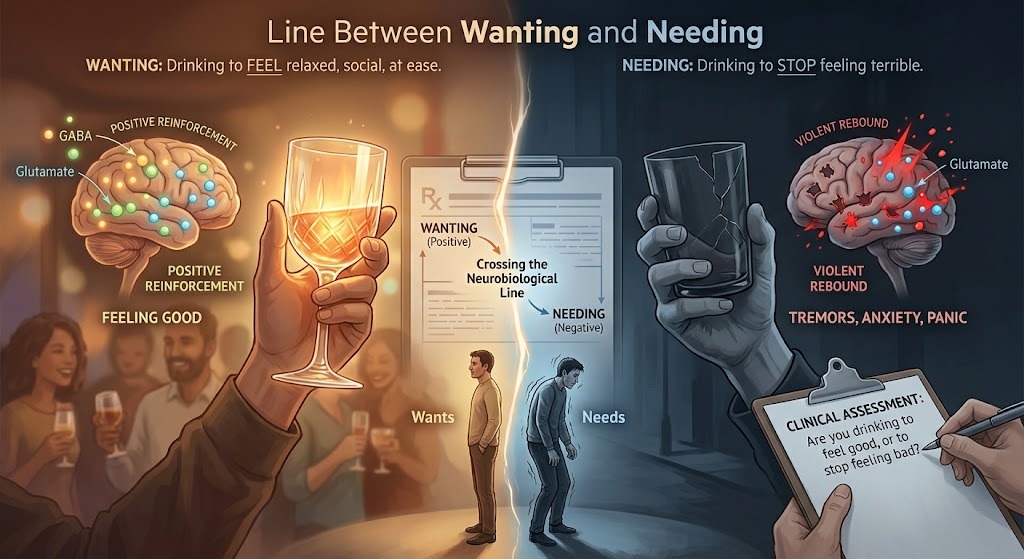
The real line between recreational use and dependence is neurobiological. In the beginning, alcohol is driven by positive reinforcement; people drink to feel relaxed, social, at ease. Alcohol boosts the brain’s calming chemical (GABA) and suppresses its excitatory one (glutamate).
But to survive constant sedation, the brain adapts. It reduces its natural GABA receptors and ramps up glutamate. Now, when alcohol leaves the system, the brain swings into a violent rebound: tremors, severe anxiety, agitation, panic. At this point, the person is no longer drinking to feel good; they’re drinking to stop feeling terrible. Clinicians identify the crossing with one question: “Are you drinking to feel good, or to stop feeling bad?”
Understanding this is the first step in how to stop drinking alcohol the right way, because once the brain has adapted, willpower alone is no longer enough.
"He can stop if he wants to": Why This Is Not True
Once dependence sets in, the belief that someone can simply “stop if they want” becomes a biological impossibility without support. Chronic drinking physically weakens the prefrontal cortex, the brain’s centre for impulse control and weighing consequences.
So when someone sincerely promises their family they’ll quit, they usually mean it. But under stress or a trigger, that weakened “knowing” brain is physically outvoted by the hijacked “wanting” brain. This isn’t a moral failure. It’s neurology, and it’s exactly why structured alcohol use disorder treatment works where promises don’t.
Why Stopping Suddenly Is Dangerous
Because the brain becomes chemically dependent on alcohol to stay balanced, quitting abruptly can be life-threatening, triggering severe withdrawal and, in some cases, seizures. This is why alcohol withdrawal treatment in Pakistan should never be attempted alone at home.
Safe alcohol detox in Pakistan must be medically managed. At Sanctum, medically supervised alcohol detox in Islamabad is handled by clinicians who manage withdrawal safely and comfortably, forming the foundation for everything that follows.
How Alcohol Dependence Is Treated
Effective alcohol addiction treatment in Pakistan goes far beyond detox. As a dedicated alcoholism treatment centre in Pakistan, Sanctum follows the Lifeline Signature Model through structured residential phases: safe detox, then therapy to rebuild coping skills, then deep work on the underlying wounds that drinking was masking.
Our inpatient alcohol treatment in Pakistan combines clinical rigour with a calm, private setting, because recovery needs both. For families seeking private alcohol rehab in Pakistan, this residential structure removes the triggers of daily life and gives the brain time to heal.
Moving Past Shame
In Pakistan, alcohol carries heavy religious and cultural stigma, which intensifies shame and drives families to hide the problem for years, delaying life-saving care. Yet that same cultural framework can become a source of recovery. By using neuroscience to reframe addiction as a treatable medical condition rather than a moral failing, families move from blame to support. For Muslim patients, the concept of Tawbah, the mercy of sincere return, can restore the hope that sustains long-term sobriety.
Getting Help
If you’ve thought “I can’t stop drinking”, or you’re searching for alcohol rehab for a family member in Pakistan, that recognition is the beginning of recovery, not a failure.
As a discreet, luxury alcohol rehab in Pakistan, Sanctum offers medically supervised care with complete confidentiality. If you’ve been looking for alcohol rehab near you in Islamabad, help and lasting recovery begin with one private conversation.
If you or someone you love is struggling with alcohol, contact Sanctum Private Rehab for a confidential assessment.
Mr. Fazal Wahid – Founder & CEO, Sanctum Private Rehab
Architect of the Lifeline Signature Model and a pioneer of system-driven addiction recovery, Fazal Wahid brings world-class, structured care to Pakistan. A King’s College London psychology graduate with postgraduate training in Addiction Science, he has refined 15 years of clinical practice into one teachable system of recovery.
[ Learn more about Mr. Fazal Wahid ]
This article is adapted from Fazal Wahid’s book, Lifeline: The Complete Treatment Model. It draws on his clinical work and is written by the Sanctum team.