In many families across Pakistan, the most dangerous kind of addiction is the one that looks like legitimate treatment. When medication is prescribed by a doctor, patients and relatives often assume it cannot be a substance use disorder. The reality is more complex: prescribed medication can cross the line from medical support into clinical dependence, especially once tolerance, dose escalation, or compulsive use begins.
At Sanctum Private Rehab, a luxury drug and mental health rehabilitation centre offering prescription drug rehab in Islamabad, we help families recognise the early signs of prescription medication dependence before it becomes severe and difficult to reverse.
Why Prescription Dependence Is So Hard to Identify
Prescription addiction carries a unique obstacle: legitimacy bias.
Patients tell themselves, “It’s medicine my doctor gave me,” or “I’m not addicted; I’m treating my anxiety.”
The symptoms may have been real at first. But dependence develops when the medicine stops being about relief and becomes about preventing withdrawal distress. That denial is understandable, and dangerous, because withdrawal from certain drugs, particularly benzodiazepines and alcohol, can be life-threatening.
Prescription Drug Dependence Symptoms to Watch For
Recognising prescription drug dependence symptoms means looking at behaviour, not just the prescription.
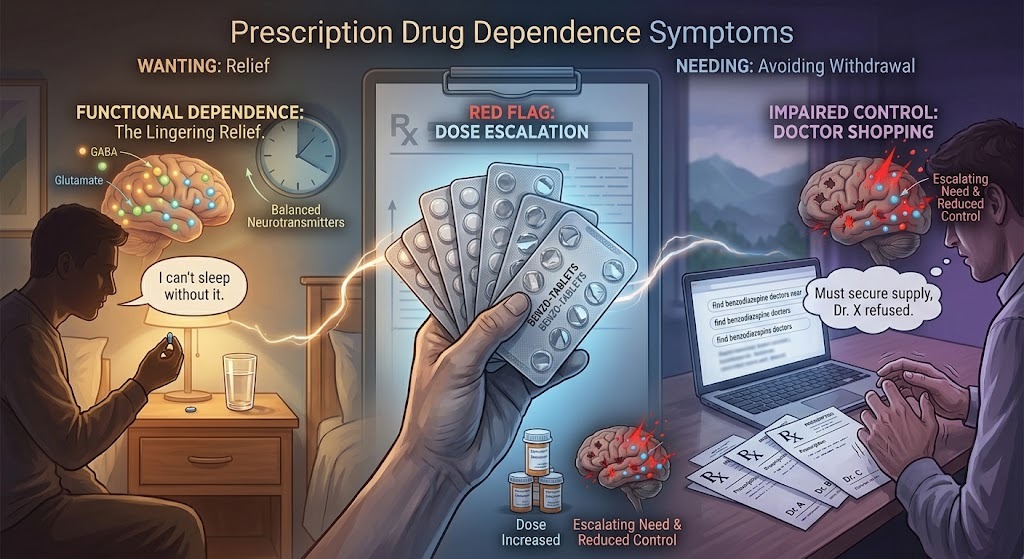
- Dose escalation is the biggest red flag, taking far more than prescribed. With benzodiazepines such as Xanax, Valium, or Lexotanil, some individuals progress toward several times the original dose just to feel normal.
- Doctor shopping, seeking multiple prescribers to maintain supply, especially after one refuses a dose increase, signals impaired control.
- Functional dependence shows in the language people use: “I can’t sleep without it,” “I can’t function without my tablets.” Beneath it lies a psychological shift, where the motivation moves from relief to avoiding withdrawal.
Medications of Highest Concern in Pakistan
Benzodiazepines and sleeping pills are the most common form of prescription dependence, often among adults aged 30–55, including many women. Prescribed for anxiety, trauma symptoms, or sleep, their withdrawal can be medically severe; abrupt stoppage can trigger seizures with fatal outcomes. This is exactly why effective sleeping pill addiction treatment in Pakistan must begin with safe clinical assessment and medically supervised tapering.
Opioid painkillers such as tramadol and codeine can lead to dependence rapidly by disrupting the brain’s reward system. Withdrawal often brings deep depression, intense distress, and heightened suicidality risk, which is why painkiller addiction treatment and tramadol addiction treatment in Pakistan should never be attempted alone.
Prescription stimulants are a rising issue among urban students and professionals chasing focus and productivity. Because access feels “doctor-like,” few label it addiction, yet tolerance, compulsion, and withdrawal-related impairment tell a different story.
Recognising Dependence as a Clinical Condition
A core strength of structured prescription drug addiction treatment in Pakistan is moving beyond self-perception to diagnosis. At Sanctum Private Rehab, our clinicians assess dependence using recognised frameworks including the BPSS assessment battery and DSM-5 criteria, identifying impaired control, tolerance, a predictable withdrawal syndrome, and a clear timeline of whether symptoms preceded the medication or were caused by it.
How to Stop Taking Painkillers Safely: Tapering Must Be Supervised
Knowing how to stop taking painkillers safely starts with one rule: for benzodiazepines and alcohol in relevant withdrawal contexts, recognition must be followed by a medically supervised taper led by a psychiatrist. Never stop abruptly after long-term benzodiazepine use. Never simply “reduce” without a clinical plan. The risk of severe withdrawal and seizures is real, and this is where quality prescription drug detox in Pakistan becomes genuinely lifesaving, not just treatment, but safe detox and structured dependency management.
A Complete Model for Recovery
Effective prescription medication dependence treatment cannot rely on willpower alone. Our care draws on the Lifeline Signature Addiction Treatment Model — developed to standardise addiction care in Pakistan, spanning five phases of healing, residential treatment followed by aftercare, a biopsychosocial-spiritual framework, family-centred education, dual-diagnosis protocols, and lifestyle medicine covering sleep, nutrition, and routine.
Families matter here too. Often the first to notice a problem, they are also the most affected by denial. We help them recognise those patterns, understand withdrawal risk, and avoid accidental enabling.
Seek Help Before It Becomes Dangerous
If someone you love is addicted to prescription medication and needs help, it isn’t a failure of character; it’s a sign the brain has adapted to the drug. Early recognition, safe tapering, structured rehab, and aftercare form the path back.
As a private rehab for prescription drug addiction in Pakistan, Sanctum combines clinical rigour with genuine comfort, so dependence is treated with dignity, safety, and lasting success.
If you or someone you love is addicted to prescription medication, contact Sanctum Private Rehab for a confidential assessment.
Mr. Fazal Wahid – Founder & CEO, Sanctum Private Rehab
Architect of the Lifeline Signature Model and a pioneer of system-driven addiction recovery, Fazal Wahid brings world-class, structured care to Pakistan. A King’s College London psychology graduate with postgraduate training in Addiction Science, he has refined 15 years of clinical practice into one teachable system of recovery.
[ Learn more about Mr. Fazal Wahid ]
This article is adapted from Fazal Wahid’s book, Lifeline: The Complete Treatment Model. It draws on his clinical work and is written by the Sanctum team.